Flexible identity: what can change and what should stay
Design variations for different contexts without turning every campaign into a different brand.
Key takeaways
- Define constants by their role in recognition.
- Allow variations with boundaries and examples.
- Test the system with extreme content and formats.
A brand needs to adapt to messages, formats, and campaigns that do not yet exist. Flexibility works when rules distinguish the stable from the variable. If everything changes, continuity is lost; if nothing can change, assets end up forcing content into a single layout.
Identify what sustains recognition
Collect current assets and observe what connects them: the logo, typography, color, framing, or tone. Do not assume they all carry equal weight. Choose constants with a clear function that you can repeat well.
Describe those constants as applicable decisions. “It feels like our brand” is a judgment; “it uses the same family, generous margins, and an image of material in context” explains what can be checked.
Make deliberate room for variation
Define what can change according to the task: image scale, number of columns, supporting color, or heading length. Preserve a shared relationship so variants belong to the same family.
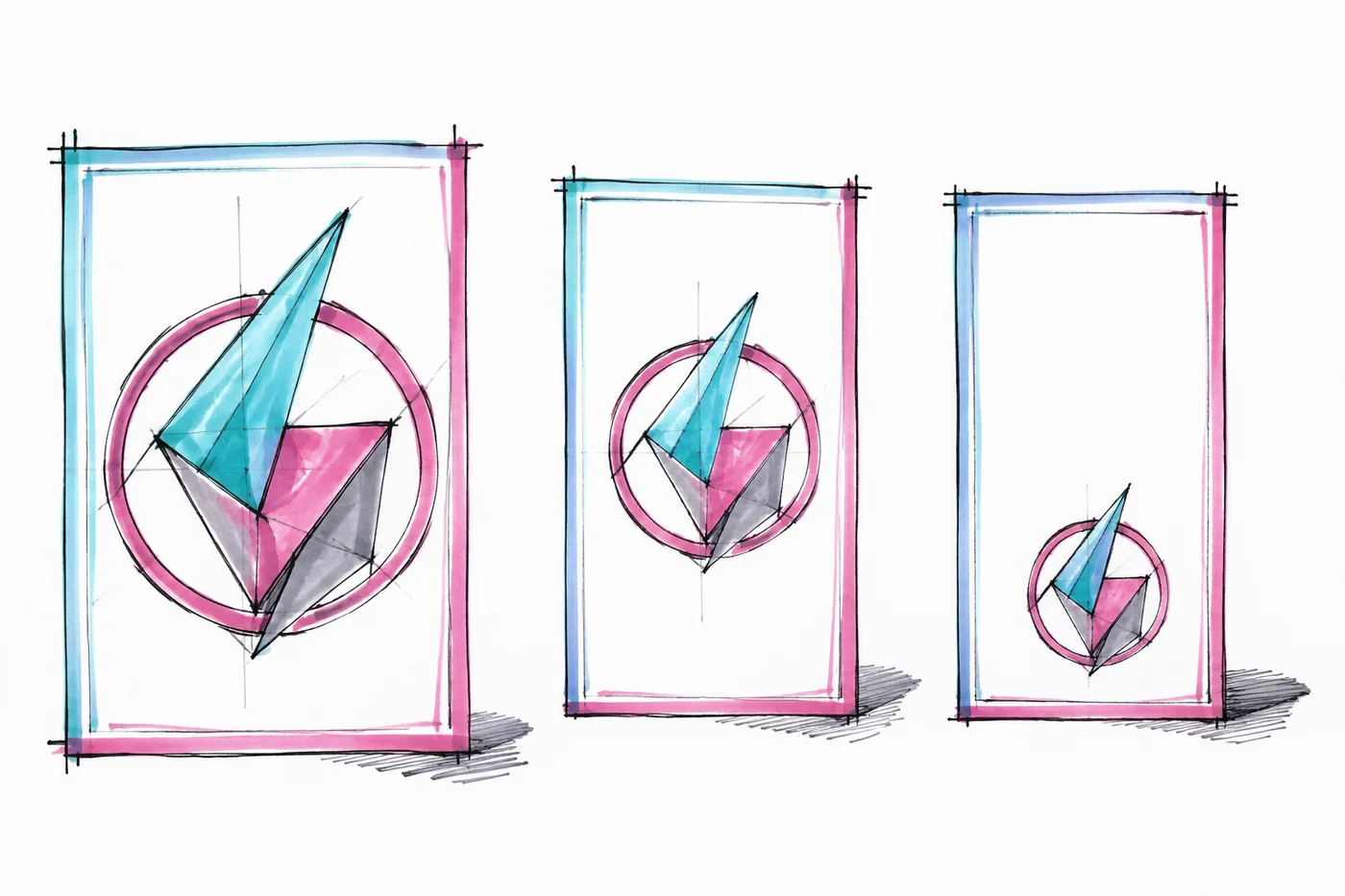
Hypothetical example: three posters retain the symbol, typography, and margins while shifting between a dominant photograph, an explanation, and an announcement. The identity remains because its constants are still visible, even though each layout solves a different need.
Set rules for combinations
Listing options is not enough. Explain which can coexist and when a combination becomes too complex. If you vary texture, typography, and layout simultaneously, the cues linking the asset to the brand may disappear.
Prepare examples of a moderate variation and one that needs simplifying. The comparison should identify the reason: hierarchy, readability, or loss of recognition. Avoid arbitrary rules that merely reproduce a personal preference.
| Element | What stays | What can adapt |
|---|---|---|
| Logo | Proportions and approved versions | Composition to fit the space |
| Typography | Families and roles | Scale and line breaks |
| Image | Art direction | Subject and framing |
| Layout | Hierarchy and rhythm | Arrangement based on content |
Test the system on difficult cases
Use a very long heading, a vertical image, an asset without photography, and a small application. Also check a translation if you work in multiple languages. These cases reveal whether the identity has resources or depends on ideal content.
When something fails, add a solution based on function. A layout for long headings is more useful than an exception named after a campaign. That way the system can reuse it when the same problem returns.
Maintain a library of current decisions
Save approved variants with their usage context and the reason they were chosen. Periodically check whether several exceptions solve the same need; perhaps they should become a shared rule.
Remove unused assets and keep the history separate. Flexibility requires understandable boundaries and a current version. A library where any variant appears approved turns freedom into uncertainty.
Design an identity that can accommodate new cases
- Choose constants and describe the function of each.
- Define variables and show approved combinations.
- Test extreme content and add reusable solutions.
Frequently asked questions
Does flexibility mean changing style for every campaign?
No. It means adapting resources within a recognizable direction. A campaign may explore further, but it should explain what it preserves and why.
How do I know if there are too many rules?
Observe whether they help production and review or constantly require exceptions. Adjust rules that do not respond to real tasks.
Can I start with just a few applications?
Yes. Document what already works and test some difficult cases before expanding. The system can grow around concrete needs.